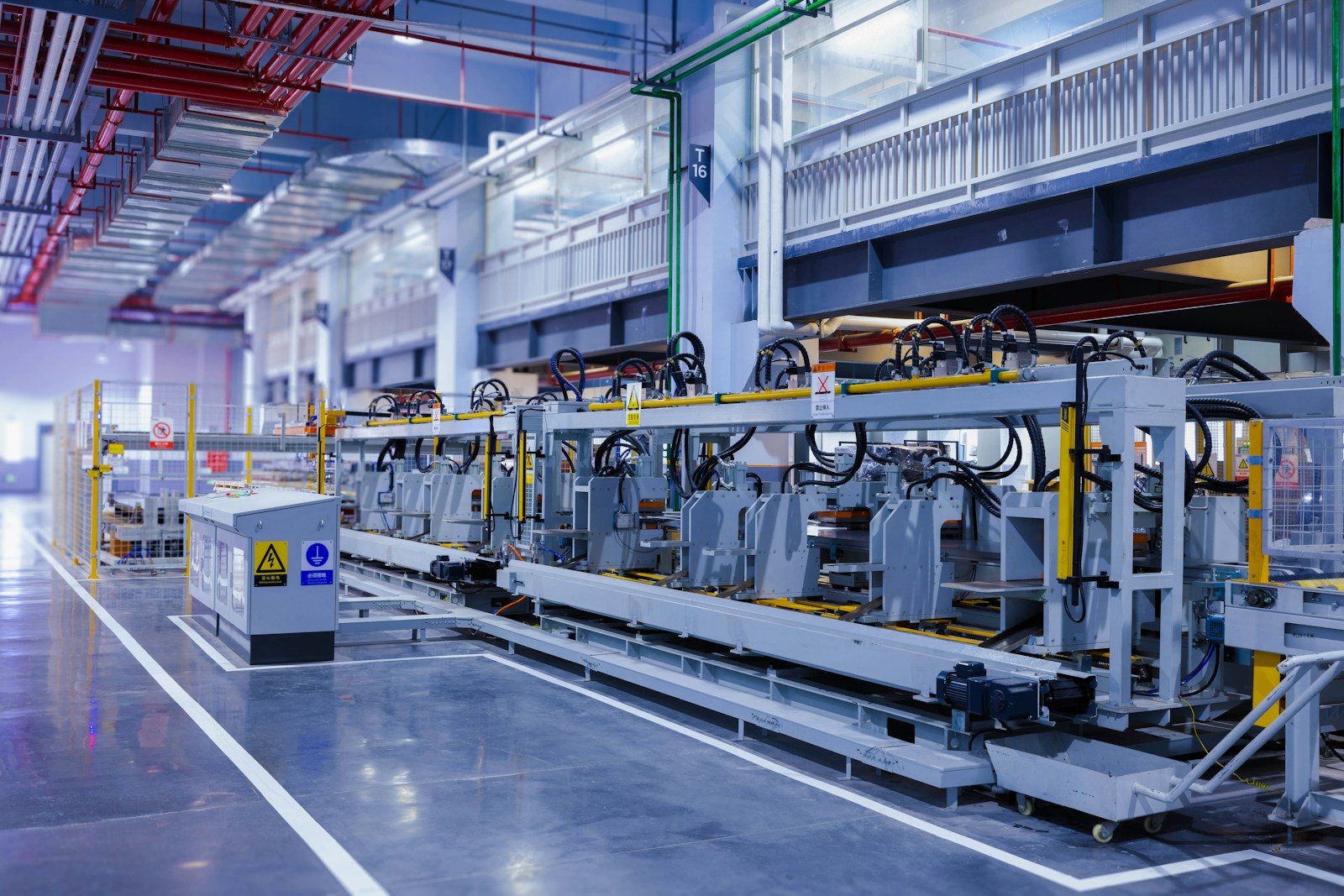
Photo by Homa Appliances on Unsplash.
A digital twin is more than a 3D picture of a factory. It is a digital model connected to information from a real asset, process or facility, allowing teams to understand what is happening, test possible changes and make better operational decisions. When artificial intelligence is added, the model can also help detect patterns in large streams of equipment and production data.
For manufacturers, the opportunity is practical: investigate a recurring bottleneck, understand why a machine behaves differently under certain conditions, or test a production change before disrupting the physical line. The challenge is building a twin that is accurate enough for the decision it is meant to support.
This guide explains where AI-powered digital twins can help, how to start with a limited pilot, and what to check before trusting the results. It is written for operations leaders, engineers and smaller manufacturers who want a realistic starting point rather than an expensive factory-wide simulation project.
What is a digital twin?
A digital twin is a digital representation of a physical asset or system that is kept relevant through data from its real-world counterpart. Depending on the use case, it may represent one motor, a production machine, a complete production line, a building or a wider facility.
The key distinction is the connection to the real system. A static 3D model can show how equipment looks. A one-time simulation can explore a particular scenario. A digital twin is designed to remain connected to changing operating information so that its representation can be updated and used over time.
The U.S. National Institute of Standards and Technology (NIST) describes manufacturing digital twins as synchronized virtual models that can help manufacturers represent, diagnose, predict and optimize operations. NIST also highlights the hard parts: consistent terminology, interoperability, trustworthiness, and methods for verifying and validating models.
Three building blocks
- The physical system: the machine, process or facility being represented.
- The data connection: sensors, machine controllers, production systems, maintenance records and other sources that describe the physical system.
- The digital model: a model that combines relevant operating data with engineering rules, simulation or analytics to answer a defined question.
A digital twin does not have to be a photorealistic 3D environment. For a maintenance use case, a well-designed model of a pump’s operating state may be more useful than a detailed visual replica of the entire factory.
Where AI adds value to a digital twin
The digital twin provides context about the physical system. AI can help interpret patterns, identify unusual behavior or estimate what may happen next. The two technologies have different jobs: the model represents and tests the system, while AI helps extract useful signals from data. Neither automatically guarantees a correct recommendation.
1. Equipment health and predictive maintenance
Consider a pump on a packaging line. Its temperature, vibration, pressure and motor-current readings can be compared with the operating conditions under which it normally runs. An analytics model may identify a pattern that deserves inspection, while the digital twin helps engineers understand whether the pattern is associated with load, speed, process conditions or a possible equipment issue.
This is decision support, not a promise that software can name the exact date a component will fail. Maintenance teams still need to check sensor quality, operating context and physical evidence before changing a maintenance plan.
2. Quality inspection and process diagnosis
Computer vision can help flag visible defects, while a digital twin can connect inspection results with machine settings, material batches and process conditions. That combination can help a team investigate whether a recurring defect is associated with a particular operating range or changeover.
Before relying on an AI inspection system, test it on representative products and lighting conditions. Track both missed defects and false alarms. A system that flags too many good products can slow production just as a system that misses defects can harm quality.
3. Production planning and bottleneck analysis
A production-line model can be used to explore different product mixes, shift patterns, changeover sequences or machine constraints. AI may help estimate demand or identify patterns in historical delays; simulation can then help planners compare possible schedules before they are applied.
Start by modelling one constraint, such as a shared machine or a long changeover. Do not assume that a simulated improvement will appear on the shop floor until the assumptions are checked against actual production.
4. Energy and resource management
Digital models can help teams understand how operating schedules, equipment loads, heating, cooling or compressed-air demand interact. AI-based forecasting may help identify periods of unusually high consumption or predict demand, while simulation can help compare operating scenarios.
For a useful pilot, select one measurable system and compare energy use against a clearly defined production measure. A lower energy bill is not automatically an efficiency improvement if output, product mix or operating hours also changed.
Why digital twins are receiving more attention in 2026
Digital twins are increasingly being used beyond individual machines. In a March 16, 2026 announcement, NVIDIA described its Omniverse DSX Blueprint for creating physically accurate digital twins of large AI-factory infrastructure. The announcement describes modelling and simulating elements such as power, cooling, networking and operations before or during facility buildout.
This is a vendor-announced reference design, not independent proof that every deployment will deliver a particular saving. It does, however, illustrate an important direction: digital twins can bring multiple engineering and operational systems into a shared environment so that teams can examine how changes in one area may affect another.
NIST’s manufacturing digital-twin work makes a complementary point: reliable twins need clear requirements, effective data management and models that can be verified and validated. The technology is not simply a graphics project; its value depends on whether the model is trustworthy for the decision being made.
How to start: a six-step digital-twin pilot
Step 1: Choose one operational problem
Begin with a recurring issue that has an owner and a measurable cost or consequence. Examples include unexpected stoppages on one machine, repeated quality rework at a particular process stage, or a production bottleneck that makes schedules unreliable.
Write the question in plain language. For example: “Can we identify operating conditions that regularly precede unplanned stoppages on this compressor?” This is a stronger starting point than “We need an AI digital twin.”
Step 2: Map the asset and its data
List the equipment involved, the sensors and controllers already available, the data collection frequency, and the systems that hold maintenance or production records. Identify who owns each data source and who understands the physical process.
Check whether timestamps align, whether units are consistent, and whether gaps or sensor faults are recorded. A sophisticated model cannot compensate for measurements that are mislabeled or disconnected from operating context.
Step 3: Build the smallest useful model
Represent only the machine or process needed to answer the question. Depending on the task, this may be a process-flow model, an equipment-state model, a physics-based simulation or a visual 3D representation. Choose the simplest model that can support the intended decision.
Step 4: Establish a baseline before adding AI
Record current performance using a defined measurement period. Depending on the problem, useful measures may include unplanned downtime, scrap and rework, maintenance response time, energy per unit, schedule adherence or the frequency of false alarms.
First confirm that the data and model describe normal operations adequately. Then test whether AI adds value beyond existing rules, alarms or engineering analysis. If a simple threshold already solves the problem reliably, adding a machine-learning model may not be worthwhile.
Step 5: Validate the model against reality
Compare model outputs with observed equipment behavior and known operating events. Test different loads, product types, environmental conditions and unusual but plausible scenarios. Document where the model is reliable and where it is not.
NIST research on digital-twin credibility emphasizes verification, validation and uncertainty assessment. In practical terms, ask three questions: Was the model built correctly? Does it represent the real system well enough for this use? How uncertain are its outputs under the conditions that matter?
Step 6: Keep recommendations under human control
For an initial deployment, let the system alert, explain and recommend rather than directly changing machine settings. Route recommendations to the engineer, maintenance lead or operator who has authority to review them. Record what was recommended, what action was taken and what happened afterward.
Only consider more automated control after the model has been validated for the relevant conditions, safety requirements have been reviewed, and a tested fallback is available. Keep operational technology segmented and restrict access to the systems that can affect physical equipment.
A practical example: a digital twin for a packaging line
Imagine a manufacturer whose packaging line experiences intermittent slowdowns. The team does not begin by modelling the entire factory. It selects the conveyor and filling machine associated with the recurring issue.
- It collects machine speed, stop events, motor current, product type and changeover records.
- It checks that timestamps and machine-state labels are consistent.
- It builds a process model showing how the selected machines depend on one another.
- It compares historical slowdowns with operating conditions and uses analytics to flag patterns worth investigating.
- Engineers test the likely causes during controlled production windows and compare the model’s predictions with observed behavior.
- The team reviews whether downtime, response time or schedule reliability improved against the baseline.
The example is a proposed implementation pattern, not a claim about a measured customer result. Its lesson is that a narrow, testable model can be more useful than a large virtual factory that has no clearly defined operational question.
Common mistakes to avoid
- Starting with a factory-wide replica: broad scope increases integration work before the business value is clear.
- Confusing a dashboard with a twin: displaying sensor readings is useful, but it does not by itself create a validated model of the physical system.
- Ignoring data quality: missing timestamps, sensor drift and inconsistent units can make outputs misleading.
- Assuming AI is always required: process models, engineering rules and conventional analytics may solve the first problem more simply.
- Trusting simulation without validation: a model can look convincing while its assumptions do not match the real process.
- Connecting systems without security planning: protect operational technology, control permissions and define how data can move between business IT and factory systems.
- Failing to maintain the model: equipment, software, materials and operating procedures change. A twin needs ownership and periodic review.
How to measure whether the pilot is worth expanding
Choose one primary outcome before the pilot begins, then add supporting measures that explain why it changed. For example:
- Reliability: unplanned downtime, stoppage frequency or mean time to detect a problem.
- Quality: scrap, rework, missed defects and false-positive inspection alerts.
- Productivity: throughput, changeover time and schedule adherence.
- Energy: energy consumed per unit of good output, with production mix and operating hours accounted for.
- Maintenance: unnecessary interventions, emergency work and time spent diagnosing faults.
Compare results with the baseline and document other changes that may have affected performance. If the pilot does not produce a reliable improvement or a clearer operational decision, refine it or stop before expanding the scope.
Do smaller manufacturers need an expensive 3D platform?
Not necessarily. A small manufacturer may already have useful information in machine controllers, maintenance software, spreadsheets, quality systems or energy meters. The first step may be connecting and cleaning a limited set of data, then building a simple process or equipment model.
When evaluating vendors, ask whether you can export your data and models, connect equipment from different suppliers, document model assumptions, control user permissions and validate outputs independently. Avoid committing to a large platform until the pilot proves that the underlying use case is worth scaling.
Frequently asked questions
Does every digital twin need artificial intelligence?
No. A digital twin can use engineering models, simulation and operational rules without machine learning. AI is useful when it improves pattern detection, forecasting, inspection or decision support enough to justify its additional complexity.
Does a digital twin have to update in real time?
No. The required update frequency depends on the decision. A machine-protection use case may need fast data, while capacity planning or energy analysis may work with periodic updates. Choose the interval based on the physical process and the risk of acting on stale information.
Is a 3D model essential?
No. A 3D environment can help with spatial planning, layout and complex facilities, but many useful twins are built around process diagrams, equipment states, engineering models and time-series data.
How can a business tell whether its digital twin is trustworthy?
Define what the model is intended to predict or support, compare its outputs with real observations, test it under relevant operating conditions, quantify uncertainty where possible, and document limitations. Trust should be earned for a specific use case rather than assumed because the model looks realistic.
Conclusion
AI-powered digital twins can help manufacturers connect operational data with models that support better maintenance, quality, planning and resource decisions. But the strongest starting point is not a giant virtual factory. It is one clearly defined problem, a small and well-understood data set, a model that can be checked against reality, and a team that remains responsible for decisions.
Start narrow, measure honestly and expand only when the evidence supports it. That is how a digital twin becomes an operational tool rather than another technology demonstration.
Further reading and sources
- NIST — Digital Twins for Advanced Manufacturing: research on requirements, data management, standards, model validation and uncertainty.
- NIST — Credibility Consideration for Digital Twins in Manufacturing: research discussing verification, validation and uncertainty quantification.
- NVIDIA Newsroom — Omniverse DSX Digital Twin Blueprint, March 16, 2026: a vendor announcement describing digital-twin simulation for AI-factory infrastructure.
- Siemens — Digital Twin Technology: an overview of digital twins across engineering and manufacturing.
Featured image: Homa Appliances / Unsplash.
About the Author